Nep Denim Coasters: Craft Project Guide

A Comprehensive Look at Selvedge Denim Material

One solitary set of antique Levi’s 501s hailing from the 1940s fetched $87,400 at an auction. Why were these trousers valued higher than a high-end automobile? The answer lies in their selvedge denim material construction.

This high-end denim stands for more than simple material. It connects us to a time when James Dean wore his 501s in Rebel Without a Cause and Marlon Brando defined cool in The Wild One. Those pop culture legends weren’t merely clad in denim. They wore Nep denim crafted on vintage shuttle looms.

Craft denim derives its title from the self-finished perimeters that avert fraying. The word “selvedge” fuses “self” and “edge” to depict this singular weaving approach. Unlike mass-produced jeans, each yard of selvedge denim material takes time and skill to create.

Its feel conveys a history through faint irregularities and innate variations. Each iteration gains personality as the indigo lightens. This unique aging grants heritage denim its special appeal among collectors and fashion devotees alike.

Many believe premium denim lasts longer than regular jeans. The reality, however, is more delicate. Selvedge crafting produces lovely material with tidy edges and robust texture. But strength depends on cotton quality and weight, not just weaving technique. What differentiates artisanal denim is its knack for aging with grace and creating singular fading designs in the long run.

What Is Selvedge Denim Material

Selvedge denim textile differs from common denim on account of its exclusive construction and self-finished edges. It’s named for its “self-edge,” a tightly woven band that prevents fraying. This high-grade material signifies allegiance to slow fashion and age-old craft, marking a contrast with mass-made denim.

black selvedge denim fabric

What Self-Edge Construction Signifies

The word “selvedge” fuses “self” with “edge,” indicating material with a tidy, sealed edge. This narrow selvage forms along both fabric sides, eliminating the need for additional finishing. Old-school mills craft it at roughly 30–32 inches wide, unlike contemporary denim’s 60-inch span.

Shuttle Looms and Their Unique Fabric Borders

Denim from shuttle looms derives its persona from antique weaving machines running at reduced speeds. They pass one weft yarn across all warp threads in a single sweep. This method results in:

  • Organic textural slubs
  • A gentler hand-feel compared to contemporary denim
  • Firmly locked edges that avoid fraying
  • Genuine irregularities prized by denim fans

Difference Between Selvedge and Standard Denim

Regular denim comes from projectile looms firing weft yarns over broader widths. This method leaves loose threads at the edges, needing overlocked seams to prevent fraying. Selvedge denim fabric, by contrast, demands more time to make. It offers superior durability and a unique aesthetic, justifying its higher cost.

The Heritage and History of Shuttle-Loomed Denim

Heritage denim’s story began in 19th-century American textile mills. Shuttle looms were central, weaving material with sealed edges to avoid fraying. This method produced indigo-dyed denim at a slow, meticulous pace, ensuring each yard was crafted with care. The narrow width of this fabric became a hallmark of artisanal denim production.

From 19th-Century U.S. Mills to Contemporary Revival

For over a century, American mills relied on shuttle looms. Brands like Cone Mills and White Oak supplied premium denim to workwear companies. By the 1970s, faster projectile looms took over, replacing most shuttle equipment. This shift was driven by the need for cheaper, mass-produced jeans. Many historic mills closed or modernized, leaving vintage looms to gather dust.

The Rise of Japanese Selvedge Excellence

During the 1980s, Japanese mills resurrected U.S. shuttle looms. Leading the charge were the Osaka Five brands:

  • Studio D’Artisan
  • Evisu
  • Fullcount
  • Warehouse
  • Denime

They combined American heritage style and Japanese meticulousness. They studied old Levi’s patterns, recreating classic indigo-dyed denim textures. By 2000, Japanese makers had overtaken the global artisan denim market.

Why Old-School Weaving Techniques Matter Today

Shuttle looms produce unique fabric characteristics that modern machines can’t match. Their reduced-speed weaving enables uneven textures and richer indigo absorption. Premium denim enthusiasts cherish these imperfections as signs of authentic craftsmanship.

Shuttle Loom Features Modern Loom Features
29-31 inch fabric width 60+ inch fabric width
3-4 yards per hour 15-20 yards per hour
Natural irregularities Uniform texture
Self-finished edges Cut edges requiring overlocking

Crafting Premium Denim with Vintage Looms

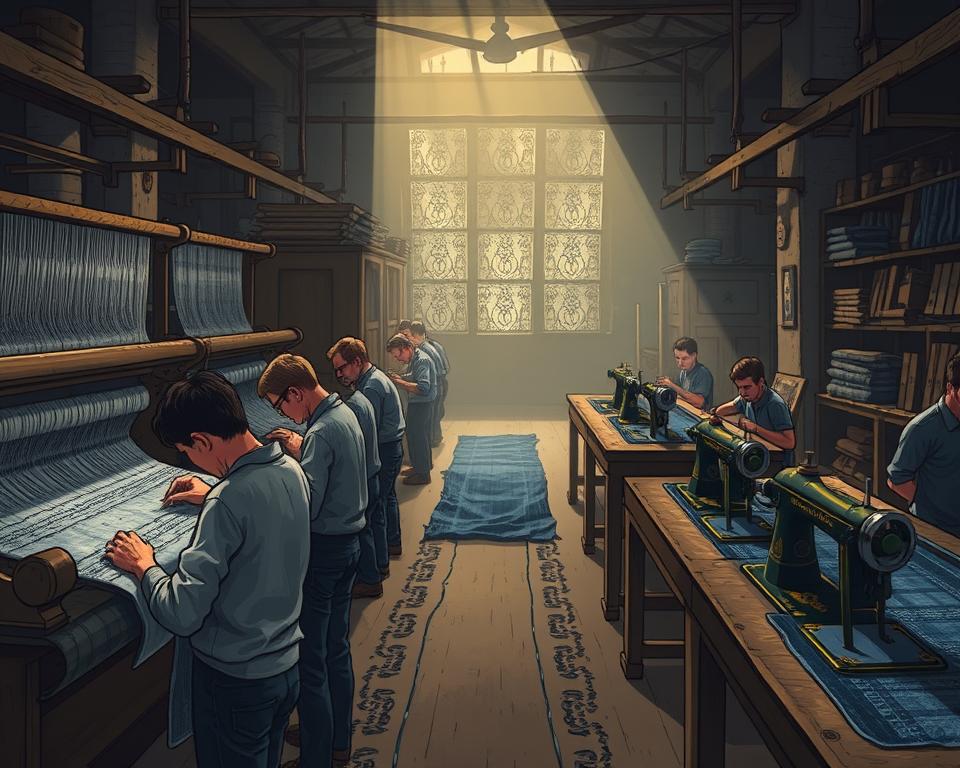
Premium denim production kicks off with the steady rhythm of antique shuttle looms. These machines differ from today’s technology. They shuttle yarn across the full width at once, binding edges without further work. This technique assures a crisp, fray-resistant edge on selvedge denim.

Antique looms run slowly, churning out only 5–6 meters of selvedge denim material per day. This sharply contrasts with current machines that manage 200 meters. The slower speed benefits the yarn in several ways:

  • Lower tension in threads produces a plusher hand
  • Inherent slubs persist, offering a one-of-a-kind texture
  • Varied surfaces produce signature fading
  • Narrow fabric width (typically 29-32 inches) reduces cutting waste

Manning these age-old looms calls for seasoned artisans. Weavers tweak tension, keep rhythm, and handle fixes. Each loom has its own unique character. Some date back to the 1920s, needing specific knowledge passed down through generations. This tactile method turns shuttle-loomed denim into an authentic artisan good.

The slender width of unwashed denim from classic looms provides practical perks. Pant makers utilize the selvedge edge as the outrigger seam, avoiding waste. This flaunts the cloth’s true craftsmanship. Every roll has its own story, with subtle variations that mass production can’t replicate.

Differentiating Raw Denim from Selvedge Denim

Numerous denim lovers conflate raw denim with selvedge denim. This misunderstanding crops up while seeking high-end jeans. The fact is they denote separate facets of denim creation. Understanding this difference guides smarter choices and deeper appreciation of each style’s uniqueness.

Why Selvedge Isn’t Always Raw

Selvedge refers to the weaving method on vintage shuttle looms, creating self-finished edges. Raw denim means unwashed fabric straight from the mill. A selvadge raw denim fabric wholesaler might offer both washed and unwashed options. Brands like Naked & Famous produce selvedge jeans, sometimes pre-washed or with stretch.

The weaving technique remains the same. Yet, the finishing process changes everything about the fabric’s feel and look.

Washed vs Unwashed Denim Options

Every denim piece begins as dry denim before washing. Factories make both regular and selvedge variants in unwashed form. The main differences are:

  • Raw denim forms distinct fade lines with wear
  • Rinse-treated denim provides quick comfort and sizing stability
  • Sanforized raw shrinks minimally post-first wash
  • Unsanforized denim shrinks notably upon soaking

Debunking Common Denim Misunderstandings

Not all raw denim comes from shuttle looms. Modern projectile looms also produce unwashed fabric. Their draw intersects as shoppers esteem resilience, personalization, and craft in selvedge and raw alike. Each style lures denim aficionados ready to devote time for bespoke fades.

Identifying Authentic Selvedge Denim Features

When hunting for herringbone selvedge denim fabric, identifying authentic selvedge denim is crucial. It distinguishes you from casual shoppers. Authentic selvedge denim features attributes absent in normal denim. Knowing these signs guarantees you’re buying true high-end denim.

Finding the Selvedge ID

The clearest way to spot selvedge denim is viewing the outseam. Cuff your jeans and check the outer-leg seam. Real selvedge denim shows a neat, sealed edge with dyed yarns interwoven. That self-finished border removes the necessity for overlock stitching typical in normal denim.

When you cuff your jeans, the selvedge ID becomes visible, adding a unique touch to your style. The colored edge yarns run continuously down the outseam, creating that signature look denim enthusiasts adore. Non-selvedge jeans, on the other hand, have cut edges covered with serger stitching to prevent fraying.

Quality Construction Hallmarks

High-grade premium denim shows distinct assembly details:

  • Tight, even weaving with no loose threads
  • Clean selvedge edges without additional stitching
  • Stable colored yarn running the full outseam
  • Heavy fabric weight characteristic of shuttle looms

Why Rainbow and Redline Selvedge Are Unique

Rainbow selvedge incorporates varied colored threads in the ID, yielding a vibrant multicolor border. Redline selvedge, the most famous variety, uses red yarns for the ID and traces back to vintage American mills. These special selvedge styles command higher prices due to their rarity and visual appeal. Many labels emphasize these traits in their descriptions, simplifying the hunt for real heritage denim.

Why Artisanal Denim Commands Premium Prices

Newcomers are often astonished by artisanal denim price tags. Selvedge jeans often cost 3–5× more than factory-made pairs.

Comprehending what drives these costs shows the actual value of premium denim.

Shuttle looms run far more slowly than contemporary looms. While industrial looms produce fabric quickly, vintage shuttle looms weave only 1-2 meters per hour. This slow process means a single roll of heritage denim takes days, not hours.

The slim selvedge widths increase expenses. Whereas conventional denim comes 60 inches wide, shuttle-loomed premium denim measures only 28–32 inches. Such narrowness demands extra planning and precision cutting to optimize usage.

Artisan denim is produced in limited lots. Mills like Okayama’s White Oak and Kuroki prioritize quality over quantity. They rely on veteran craftsmen who supervise every phase:

  • Hand-checking yarn tension
  • Adjusting loom settings for each fabric type
  • Inspecting every meter for flaws
  • Managing rope-dyeing processes that take weeks

These weavers consider their work an art form. They innovate with special yarns and refine indigo dyeing recipes inherited over ages. Buying heritage denim sustains mills upholding textile customs and craftspeople passionate about their trade.

Where to Buy Black Selvedge Denim Fabric Wholesale

The premium denim market has grown beyond Japan’s traditional mills. American brands now compete, providing a wide range of black selvedge denim fabric wholesale. Choosing the best vendor requires grasping telltale signs and true material provenance.

Finding Quality Suppliers and Manufacturers

Quality suppliers emphasize heritage weaving and a deep passion for craftsmanship. Hunting for a selvedge raw denim wholesaler? Seek out mills still running shuttle looms. They provide comprehensive fabric details: weight, weave style, and dye processes.

Gold Selvedge Denim Fabric Manufacturers to Know

Gold-ID selvedge producers spotlight rich edge threads, boosting denim opulence. Top factories craft these niche fabrics in small batches, drawing boutique labels. The gold-ID thread bestows an exclusive trim, differentiating them from usual choices.

How to Procure Nep Denim and Unique Weaves

Special weaves like nep denim warrant direct sourcing links. This textured fabric features intentional irregularities for unique visual interest. Partnering directly with mills guarantees availability of these niche weaves.

Fabric Type Minimum Order Lead Time Price Range per Yard
Black Selvedge 500 yards 6-8 weeks $12-18
Gold ID Selvedge 300 yards 8-10 weeks $15-22
Nep Denim 400 yards 10-12 weeks $14-20

Selvedge Styles and Variants

Selvedge denim’s realm extends past plain indigo. Currently, manufacturers produce varied textures and designs. They highlight the adaptability of shuttle-loom craftsmanship. Spanning delicate textural shifts to vivid motifs, they present distinct character that matures gracefully with wear.

Understanding Slub Denim Texture

Slub denim’s trademark rough texture stems from uneven yarns. They include thick and slim sections, producing an inherently varied cloth surface. Woven on shuttle looms, they form slub-textured selvedge that fades unpredictably.

Each slub denim jean yields its own one-off wear pattern. Thick slub raised zones age in contrast to smooth zones, giving each a unique look.

Herringbone Selvedge Traits

Herringbone selvedge textile shows a zigzag design similar to fish bones. The pattern forms diagonal ribs that reverse direction periodically. This motif boosts aesthetics and reinforces the cloth’s durability.

Brands like Iron Heart and The Strike Gold routinely utilize this weave in their top-tier offerings.

Striped Denim Fabric and Unique Weaves

Striped denim uses alternating threads to form vertical or horizontal stripes. Mills achieve these patterns by alternating different colored threads during weaving. Some popular variations include:

  • Hickory stripe with alternating indigo and white
  • Railroad stripe featuring thin pinstripes
  • Wabash stripe with printed dots over stripes
Fabric Type Visual Pattern Fade Characteristics
Slub Denim Bumpy, irregular surface High contrast, uneven fading
Herringbone Zigzag diagonal lines Subtle vertical streaking
Striped Denim Alternating color bands Pattern remains visible after fading

Caring for Your Heritage Denim Investment

Your heritage denim calls for tailored care to grow its special character. Unlike regular jeans, raw denim and dry denim transform with wear. They form custom fade stories unique to you.

Your first few wears in artisan denim might feel firm and odd. This is normal. The fabric needs time to soften and mold to your body shape. Certain fans quicken the break-in by shower-wearing or damp squatting in their jeans. Others prefer a slower, more natural break-in period.

Raw denim develops its best fades when you wait to wash it. Natural skin oils and daily movement produce whiskers at knees and honeycombs on the back. Numerous denim heads wait half a year before the initial wash, with some waiting a full year. That patience rewards you with bold, custom fades matching your motion.

When it’s time to wash your dry denim, turn it inside out and use cold water. Skip the spin cycle and hang dry away from direct sunlight. Some choose hand-washing in a tub with mild soap. Avoid hot water and dryers, as these can cause unwanted shrinkage and fade loss.

Your denim keeps appreciating as you care for it properly. Each wear adds character, making your jeans truly one-of-a-kind. The firm break-in becomes a flexible second skin mirroring your daily life.

Where You Can Purchase Quality Indigo Denim Now

Selvedge denim’s comeback has created fresh opportunities for fans. Major retailers now carry indigo-dyed denim alongside specialty stores focused on premium denim and slow fashion. This means shoppers can secure genuine selvedge at multiple price tiers to suit any budget or preference.

Levi’s sells its 501 Original Fit Selvedge for $148, bringing heritage craft to more people. Uniqlo offers its Selvedge Straight at $50, striking a balance between style and price. For upscale choices, Buck Mason presents Japanese Loom State Selvedge Full-Saddle Jeans at $248. Iron Heart takes premium denim to the next level with their 634s-18 Vintage Denim Jeans, priced at $385, available through Self Edge stores.

American names like Todd Snyder and Buck Mason have entered competition with Japanese maestros in the selvedge scene. They realize that classic weaving methods and excellence underpin slow-fashion success. Whether shopping online or in physical stores, quality indigo-dyed denim is more accessible than ever to American consumers who cherish authentic craftsmanship.

Precious Metal Recycler: Insurance and Liability Considerations

Mastering Eco-Friendly Precious Metal Recycling

More than $60 billion in precious metals end up in e-waste every year—did you realize that? That eye-opening statistic shows how important recycling these metals really is. It’s not just good for our economy but also for the environment. By recycling metals like gold, silver, platinum, and palladium, we cut down on pollution and save natural resources.

Firms like Dongsheng Metal Trading spearhead the movement toward greener recycling. They guarantee that valuable metals return to use instead of filling dumps. Such a precious metals recycling model drives eco-friendly recycling and sustainable methods.

Fundamental Insights

  • More than $60 billion of precious metals end up in e-waste each year.
  • Recycling precious metals shrinks environmental harm and saves resources.
  • Valuable metals include gold, silver, platinum, and palladium.
  • Sustainable development depends on eco-friendly recycling.
  • Firms such as Dongsheng Metal Trading focus on precious metal recovery.

Exploring Precious Metals and Their Worth

Precious metals are rare, naturally occurring metallic elements that have captured the interest of investors and industries alike. Gold, silver, platinum, and palladium stand out for their distinct qualities. Notable traits are excellent conductivity, corrosion resistance, and rarity. Extracting and refining them uses up huge resources, so recycling becomes critical.

precious metal recycling

Intrinsic qualities and demand in the marketplace determine precious metals’ worth. Metal recycling ensures the supply chain remains robust. It also reduces environmental impacts associated with mining activities. Through exhaustive recycling processes, these metals can be restored to their original state. Such efforts save limited resources and create economic gains.

Precious Metals Explained

These metals’ special traits lend themselves to diverse applications. Scarcity plus special properties drive their economic importance. Notable examples are:

  • Au: Prized for its shine and tarnish-proof nature.
  • Ag: Recognized for its versatility and high conductivity.
  • Platinum: Esteemed for its toughness and catalyst role.
  • Palladium: Gaining traction in cars and electronics.

Benefits of Precious Metal Recycling

The practice of recycling precious metals has emerged as a vital component for sustainability. It preserves resources and lessens the environmental cost of mining. Key benefits include:

  • Reduction of environmental degradation caused by mining operations.
  • Lower energy consumption compared to extracting new metals from the earth.
  • Contribution to a circular economy by reintroducing materials into production cycles.
  • Economic upside from extracting high-value resources.

The Importance of Precious Metal Recycling

Recycling precious metals offers substantial environmental and economic benefits. Emphasizing benefits helps cut environmental harm. Plus, it spurs economic development and steadiness.

Eco Advantages

Recycling metals yields major environmental perks. By reclaiming metals from discarded electronics and industrial scrap, we cut down on landfill waste. That cuts new mining needs and saves resources.

This approach minimizes the harmful effects of mining, such as habitat destruction and pollution. By prioritizing recycling, we work toward a greener tomorrow.

Economic Benefits

Financial perks of recycling are just as strong. Using reclaimed metals trims manufacturing budgets. It lets businesses choose reclaimed over freshly mined metals.

It spawns jobs in recovery plants and steadies markets as recycled-metal demand rises. By leveraging these economic advantages, businesses can improve their profitability. They further support a cleaner economy.

How Precious Metals are Recycled

Metal recycling demands a multi-stage process to optimize recovery. First, scrap electronics, jewelry, and industrial waste are gathered. Next comes sorting, cleaning, and testing to assess metal content and worth.

The Precious Metal Recycling Process

This systematic approach is vital for effective metal recovery. All stages focus on boosting metal yield. Sorting separates metals by type and purity. Cleaning removes contaminants that could hinder recovery. Testing measures metal content to select proper recycling methods.

Recycling Techniques Used

Advanced recycling techniques are employed to achieve high metal recovery rates. Thermal reduction applies intense heat to isolate metals. Melting refines and aggregates metals, while wet chemical processes are used for delicate separations. Companies like Dongsheng Metal Trading use these methods to boost efficiency and maximize returns in the precious metal recycling process.

Which Precious Metals Are Recyclable

Recovery efforts support both ecology and resource reclamation. Many precious metals can be recycled, benefiting both the economy and the planet. Knowing which metals are recyclable helps individuals and firms.

Recycling Gold, Silver & Platinum

Gold, silver, and platinum stand out among precious metals. You’ll see them in rings, currency, and industrial parts. Recycling gold is common due to its high value and demand. Silver recovery matters too, thanks to its role in imaging, tech, and solar.

Platinum, while rarer, finds value in catalytic converters.

E-Waste Metals

Electronics scrap contains metals ripe for recovery. Gadgets—from phones to laptops—house palladium, indium, and more. Recovering such metals diminishes e-waste and yields vital materials.

It’s crucial to recover these electronic metals. Sectors strive to cut waste and boost recycling efficiency.

Industry Benefits of Precious Metal Recovery

Recycling precious metals supports industries by providing efficient, green resource supply. Device manufacturing in electronics profits hugely from recovered metals. Aerospace and medical sectors also depend on these metals for critical components. Exploring how these industries recycle precious metals reveals the environmental and economic benefits.

Electronics Industry

Electronics spearheads recovery, given the metal content in phones and PCs. Rapid technological advancements have led to a significant increase in electronic waste. Hence, recovering metals like gold, silver, and palladium is crucial. That saves resources and cuts mining carbon footprints.

Businesses enhance recovery to align with green and zero-waste aims. This shift supports the ongoing need for resource conservation and environmental protection.

Aerospace and Medical Equipment

Metal recovery is key in aerospace and medical sectors where metals are in vital parts. High-performance alloys are essential for manufacturing flight parts and medical devices due to their durability and resistance to corrosion. Recovering them cuts costs and meets green regulations.

These sectors know green recovery eases resource shortages. Plus, it boosts efficiency, cementing recycling as a sustainability strategy.

Finding Precious Metal Recycling Companies

Choosing reputable metal recyclers is vital for success. You should probe their procedures thoroughly. Knowing their pricing and processing methods can greatly affect your experience. By comparing services, you can see what each company offers and make a smart choice.

Questions to Ask Recycling Companies

  • Can you share your precious-metal recovery accreditations?
  • Can you explain your processing methods for different metals?
  • What are your recovery rates for various precious metals?
  • What is your pricing structure and are there extra charges?
  • Do you have client testimonials or references?

Evaluating Offers

When searching for a recycler, it’s vital to compare different companies based on their services. Create a table to compare key factors such as:

Company Name Recovery Rate (%) Processing Fee ($) Turnaround Time (Days)
Recycling Co. A 95 50 7
Recycling Co. B 90 45 5
Recycling Co. C 92 55 10

Comparing options ensures you get top value and service. That way, you maximize returns and maintain quality.

Your Metal Recycling Handbook

Understanding how recyclers operate is key for those interested in precious metal recycling. They oversee everything from scrap pickup to refining. This ensures maximum efficiency and value from metals.

Behind the Scenes of Recycling

Recyclers use advanced methods for metal recycling, including testing, separation, and refining. First, they gather scrap from multiple origins. Then, they use sophisticated techniques to separate different metals. Next, they refine these metals to extract precious elements like gold, silver, and platinum.

It optimizes yield while advancing environmental goals. It’s a critical step towards sustainable development.

Choosing the Right Recycler for Your Needs

Key criteria matter when choosing a recycler. First, look at their environmental practices. In today’s market, a commitment to sustainability is essential. Next, review their service range—from pickup to refining.

Cost is equally important. Gather price quotes for side-by-side comparisons. Experts like Dongsheng Metal Trading provide industry-specific offerings. They are a reliable choice for specific recycling needs.

Pick the Right Facility

Recycling centers play a key role in sustainability and waste control. It encompasses various recycling centers, each tailored to specific metal recovery needs. Knowing the facility landscape helps you connect with the right partner. This benefits both businesses and the environment.

Recycling Center Types

Metal recycling facilities vary widely in their operations. Certain centers specialize in high-value metals; others take general scrap. Common examples include:

  • General scrap yards handle both ferrous and non-ferrous materials.
  • Specialized firms recover gold, silver, and platinum with advanced refining.
  • E-Waste Recycling Centers: Specialize in recovering metals from discarded electronics, capitalizing on the valuable components often found in these devices.

Location and Access to Facilities

Easy access to facilities boosts recovery efficiency. Firms need to plan transport logistics. Key access factors include:

Factor Description
Distance Facilities located nearer to businesses minimize transportation costs and time.
Partnerships Connections with nearby facilities speed up recycling.
Services Offered Understanding the specific services of metal recycling facilities helps businesses select appropriate partners.

In sum, selecting the right type of recycling center and ensuring convenient access can significantly enhance the efficiency of metal recycling operations.

E-Waste Recycling & Metal Recovery

Electronic waste is a pressing issue in today’s world, causing environmental harm. Old gadgets hide valuable metals ripe for recovery. This highlights the importance of seeing e-waste as a valuable resource.

How Electronics Contain Precious Metals

Gadgets harbor small quantities of precious metals. These metals are found in various parts:

  • Circuit boards
  • Connectors and ports
  • Capacitors and resistors
  • Battery terminals

Even everyday items like smartphones, laptops, and TVs are filled with these metals. Recycling lets us reclaim and repurpose those metals.

Why Recycle E-Waste?

Recovering e-waste metals safeguards the environment and reclaims materials. It trims dump loads and conserves raw materials. Key perks include:

  • It lowers pollution risks tied to discarded electronics
  • It reduces CO₂ output via green recycling methods
  • It fuels a circular economy by feeding materials back into manufacturing

Championing electronics recycling fosters responsible resource use. It lays the groundwork for a greener future.

Future Trends in Metal Recovery

Metal recycling is evolving, spurred by tech advances and green initiatives. With resource conservation rising, recyclers are innovating. Adopting fresh techniques, they’re shaping tomorrow’s recycling.

Eco-Friendly Recycling Innovations

Today’s sustainable recycling prioritizes waste reduction and low impact. Businesses adopt green packaging and energy-saving techniques. That evolution supports global green targets and fosters industry responsibility.

New Metal Recovery Tech

New methods in recovery enhance recycling performance. Automated sorters and hydrometallurgy ramp up yield. They ramp up yields and shrink eco-footprints, advancing metal recycling.

Starting a Precious Metal Recycling Venture

Launching a metal recovery firm requires careful strategy and market insight. Leaders should map out steps, secure compliance, and set firm roots. Key tasks include market studies and pinpointing customer segments. Permits and regulatory clarity underpin ongoing success.

Steps to Establishing a Business

Setting up a precious metal recycling venture requires several essential steps:

  1. Conduct market research to understand needs and rivals.
  2. Create a comprehensive plan with objectives and tactics.
  3. Invest in equipment tailored to your process needs.
  4. Obtain capital via loans or investors.
  5. Secure regulatory approvals and certifications.
  6. Deploy promotional plans to gain customers.

Compliance and Certifications

Knowing regulatory requirements is vital for a recycling startup. Complying with eco-regulations keeps your business green and lawful. Must-know compliance points:

  • Securing business certification from relevant authorities.
  • Following all levels of waste and recycling regulations.
  • Training staff in safety protocols and best practices.

Final Thoughts

Precious metal recycling is essential for preserving natural resources and improving environmental health. It empowers all of us to reduce environmental harm from waste. Recovered metals curb mining and fuel green-job growth in recycling.

Metal recovery delivers both eco and economic upsides. Teaming with Dongsheng Metal Trading secures sustainable methods. Such alliances reinforce the circular economy for all stakeholders.

A sustainable tomorrow hinges on our joint metal-recycling efforts. Increased awareness builds a culture of green consumption and care. Implementing these measures supports us today and safeguards future generations.

Future Outlook for the Portable EV Charger Manufacturer Market

Premier EV Charging Cable Manufacturers for Your EV

EV adoption is booming, with the demand for trustworthy and efficient charging solutions increasing sharply. Today, industry leaders have been at the cutting edge of this change, providing premium charging infrastructure. Southwire, for instance, has been a significant player since 2014, garnering 1000+ five-star reviews and a 75-year legacy in electrical construction.

The surge in electric vehicle adoption creates a requirement for long-lasting, quick, and reliable EV Charger Manufacturers. Top manufacturers are pioneering to meet these evolving needs, offering solutions that boost the overall charging experience.

Grasping the variations between various charging solutions matters for choosing correctly. High-grade charging infrastructure has a direct effect on vehicle performance and customer satisfaction.

Primary Conclusions

  • Top manufacturers offer high-quality charging cables for improved durability and safety.
  • Growing EV adoption fuels demand for fast, reliable infrastructure.
  • Leading companies innovate to meet the evolving needs of electric vehicle owners.
  • High-grade cables improve energy transfer and driving range.
  • Buying premium chargers pays off over time.

EV Charger Manufacturers

The Growing Importance of Quality EV Charging Cables

As electric vehicles become increasingly popular, the significance of premium EV charging cables is immense. The efficiency, safety, and reliability of electric vehicle charging systems hinge upon the quality of the charging cables used.

The Evolution of Electric Vehicle Charging Technology

Charging tech for EVs has evolved rapidly, with a priority on faster charging speeds and enhanced protections. Today’s EV charging cables are built for these requirements, featuring high-grade materials and advanced designs to minimize energy waste and maximize transfer rates.

Why Quality Matters in EV Charging Infrastructure

Quality charging cables directly impact the overall performance and safety of EV charging infrastructure. Robustness, such as all-weather performance and temperature tolerance, maintain performance in harsh conditions. Additionally, regulatory compliance and adherence to industry guidelines are crucial in guaranteeing safe operation.

Key Features Benefits
Superior materials and construction Minimized power loss during energy transfer
Robust durability All-weather reliability
Regulatory compliance Certified safety
Maintainability Long-term value proposition, reduced waste

Aichie Tech Electronics’ premium cables undergo rigorous testing at The Cable Lab. Choosing maintainable Portable EV Charger, owners save money long-term through repairs, reducing waste and protecting the planet.

Top EV Charging Cable Manufacturers in China

A surge of cable makers in China supports the EV boom. They play a key role in global EV infrastructure, offering premium charging cables designed for different applications.

Wottz – Top EV Cable Maker from 2014

Wottz has been a leading cable manufacturer since 2014. They offer a range of cables that meet the specific requirements of EV charging systems, from Mode 1, 2, 3, and DC Fast Charging (Mode 4).

Aichie Tech Electronics’ 75-Year Legacy

Aichie Tech Electronics leverages 75 years of electrical expertise in its EV cables. Their products are designed to meet the demands of both domestic and commercial EV charging infrastructure.

More Leading EV Cable Brands

Specialists in Type 1/Type 2 connectors and environmental-resistant cables are emerging players. These include Type 1 & 2 connector experts, as well as companies developing cables with enhanced flexibility and resistance to environmental factors.

Types of EV Charging Cables Explained

As electric vehicles become increasingly popular, understanding the various types of EV Charging Cables is crucial for optimal charging experiences. Different cables suit different charging needs. The variety in EV charging infrastructure demands a closer look at the cable options.

Comparing SAE J1772 and Mennekes Cables

Type1 and Type2 charging cables are two common standards used for EV charging. Type 1, also known as SAE J1772, is North American standard, while Type 2, or Mennekes, is the European norm. The right cable matches your car and charger. Type 2 cables often handle greater power, making them suitable for faster charging.

Level 2 & Fast DC Cables

Level2 charging cables offer faster charging than Level1, using 240V AC power to deliver up to 19.2 kW of power. DC Fast Charging cables, on the other hand, provide rapid charging by converting AC power to DC within the charging station, allowing for much faster charging times. These cables are essential for long-distance EV travel, enabling drivers to recharge quickly.

Granny Chargers vs Tethered Units

Portable EV charging cables, such as “Granny chargers,” offer flexibility by allowing owners to charge their vehicles from standard household outlets. Tethered cables are fixed to charging stations, offering ease at the cost of portability. The choice depends on the owner’s charging needs and preferences.

Cable length, power rating, and connector type matter most. For instance, portable charging cables range from basic Level1 emergency chargers to more robust Level2 solutions. Vehicle-to-load (V2L) cables represent an emerging category, enabling EVs to power external devices.

  • Portable charging cables offer flexibility, with options ranging from basic to more robust Level2 solutions.
  • Fixed cables add convenience, removing cable management tasks.
  • Lengths vary from 5 m to 50 m—choose wisely.

Attributes of Premium EV Cables

High-quality EV charging cables are distinguished by several key features that ensure reliable and safe charging. These features are vital to safe, efficient charging.

Durability and Weather Resistance

Cables must withstand rain, sun, and cold. Manufacturers like Wottz and Southwire craft their cables from recyclable materials that adhere to ROHS compliance, ensuring they perform in harsh climates. Their repairable builds support longevity and eco-reuse.

User-Friendly Design

Flexibility and ease of use are also critical factors. High-quality EV charging cables are designed to be flexible, making them easier to handle and maneuver. This flexibility is combined with rugged construction for lasting performance.

Certified Safety and Standards

Approved safety marks ensure reliable performance. They ensure their products meet or exceed standards such as IEC62196 for connectors and UL2594 in North America. Rigorous third-party testing evaluates electrical safety, mechanical durability, and environmental resistance.

Certification Description Region
IEC62196 Connector safety standards International
UL2594 Standard for electric vehicle supply equipment North America
ROHS Restriction of hazardous substances International

By focusing on these key features, manufacturers can provide EV charging cables that not only meet the highest quality and safety standards but also enhance the overall user experience.

Innovative Technologies from Leading EV Charging Cable Manufacturers

The latest developments in EV charging cable technology are revolutionizing the way we charge our vehicles, with a focus on speed, improved signal integrity, and sustainable compounds.

Liquid Cooling for Rapid EV Charging

Liquid-cooled charging cables are emerging as a key technology for ultra-fast charging, minimizing thermal throttling during high-power sessions.

Advanced Connector Tech

Hyperboloid contacts are being integrated into EV charging cables to enhance signal integrity, ensuring stable communication and power flow.

Eco-Friendly Cable Compounds

Companies focus on green materials, using recyclable materials and eco-friendly compounds that reduce environmental impact. For instance, companies like Aichie Tech Electronics and Wottz are adopting serviceable design philosophies and RoHS compliance to minimize waste and promote recycling.

The industry’s shift towards sustainability includes the use of TPU jackets, avoidance of hazardous substances, and the development of take-back programs for end-of-life disassembly and material recovery.

Choosing the Perfect EV Cable

Choosing the right EV charging cable is crucial for efficient and safe charging. To make an informed decision, consider several key factors.

Connector Compatibility

Ensure the charging cable is compatible with your vehicle’s connector type. Your vehicle’s onboard charger capacity sets the upper limit for AC power.

Length Considerations

Select a cord length based on parking and outlet location. A longer cable adds reach at the cost of extra weight.

Power Rating & Charge Rate

Ensure cable amperage aligns with charger and car. Standard Level 2 home charging operates at 7.2 kW, but some vehicles support up to 19.2 kW with appropriate electrical service.

Mind these points to pick a cable that fits your EV lifestyle.

Conclusion: Investing in Quality EV Charging Infrastructure

With EV growth unabated, premium cables are essential. Investing in premium EV charging cables from established manufacturers like Wottz and Aichie Tech Electronics ensures superior durability and lower lifetime costs. Their serviceable designs allow for component replacement, reducing waste and costs. This approach supports eco-friendly EV use.

Premium cables offer certification, future proofing, and reliability.

Color Fastness Testing Procedures for Fiber Coloring Machines

What’s Ahead for Data Transfer: Advances in Fiber Optic Communications

Were you aware a single hair-thin strand can now carry over 100 terabits of data per second? That capacity could handle streaming 12 million HD films at once—quite a jump compared to the 1950s, when researchers began using light for rudimentary signaling.

  • Data transmission rates 100x faster than old copper lines
  • No disruption from electrical or radio noise
  • Ability to handle 5G infrastructure and 8K video
Characteristic Copper Wiring Fiber Optic Cables
Data Rate 10 Gbps max Exceeding 100 Tbps
Distance 100 meters 70+ kilometers
Security Prone to tapping Highly resistant to eavesdropping

Light pulses bounce through glass cores using total internal reflection, similar to a laser light bouncing in a mirrored corridor. This optical principle avoids data loss across vast spans. With growing video conferencing and IoT devices, these fibers prevent network overloads – Fiber cable sheathing line.

Evolution of Fiber Optic Communication Technology

Decades of innovation transformed light-based data transfer from theory to reality. Researchers in the 1950s discovered that glass strands could guide light—a concept that reshaped modern connectivity.

37726707 6A14 4A44 B2C2 F3431F0Dd0C7

Early Experiments and Pioneers

Narinder Singh Kapany made history in 1952 by proving light could travel through bent glass. He named the field “fiber optics,” establishing the basis for modern fiber networks. Together with Harold Hopkins, he created pliable imaging bundles, which became prototypes for data-carrying fibers.

By the 1960s, labs demonstrated practical uses for these strands. Although initial implementations suffered loss, ongoing experiments improved their efficiency. Researchers found that ultra-purified glass cores extend signal reach with minimal distortion.

Key Fiber Optic Breakthroughs

The 1970s marked a turning point with the first commercial installations. Telephone companies adopted cables that replaced copper lines, boosting call clarity and capacity. In 1970, Corning Glass Works introduced low-attenuation fiber capable of 65 km spans.

Date Achievement Impact
1977 First live phone traffic Proved real-world reliability
1988 Launch of TAT-8 transatlantic link Connected continents
1990s Erbium-doped amplifiers Enabled long-distance networks

Today’s innovations prioritize higher throughput and expandability. Dense wavelength-division multiplexing (DWDM) now lets single strands carry multiple data streams simultaneously. Such progress connects laboratory research to worldwide network infrastructures.

Basic Principles of Fiber Optic Data Transfer

Light travels faster than anything else—so why not use it to send messages?. This straightforward concept underpins contemporary networks. Rather than electrons in metal cables, photons traverse geographic barriers. Below is the fundamental mechanism.

Photon-Based vs. Electron-Based Signaling

Optical signals transmit data more effectively than electrical currents. Light particles:

  • Travel at ~186,000 mi/s (~99.7% of c)
  • Don’t create heat or electromagnetic interference
  • Support simultaneous multi-wavelength channels
Factor Electrons (Copper) Photon Signaling (Fiber)
Data Rate Max ~10 Gbps 100+ Tbps
Noise Susceptibility Vulnerable to electrical noise Immune
Energy Use Greater energy demand Lower energy requirement

The Mirror Effect Inside Glass Strands

Photons remain confined within the fiber’s core by total internal reflection. Because the core’s refractive index exceeds that of the cladding. Upon striking the boundary at a critical angle, it reflects internally, traveling long distances.

This design prevents signal loss. Over extensive spans, nearly 95% of photons arrive intact. Paired with precise lasers, it guarantees clear video conferencing and rapid downloads.

Different Types of Fiber Optic Cables

Not all glass strands are created equal. The right cable type depends on how far your data needs to travel and how much information you’re sending. Let’s break down the two main categories and their specialized designs.

Attribute Single-Mode Multi-Mode
Core Diameter ~9 microns ~50–62.5 microns
Bandwidth 100+ GHz 35–500 MHz
Max Distance ~120 mi ~1,600 ft
Typical Applications Telecom networks Local area networks

Hospitals use single-mode for MRI image transfers between buildings. Educational institutions choose multi-mode for intra-campus video streaming on a budget. Both types keep our world connected, just in different ways.

Fiber Optic Cable Construction and Key Components

Curious how connectivity persists despite storms? This is due to advanced cable engineering. Multilayer structures shield information as it moves at near-light velocity.

Core, Cladding & Coating Explained

At the heart of every cable sits the glass core—thinner than a human hair. This pure glass guides photons via total internal reflection. The cladding layer, with a lower refractive index, reflects stray light back into the core.

An acrylate polymer coating encases the cladding and core. This ~250 µm barrier safeguards against physical abrasions and water ingress. Together, these components form the light-carrying highway inside every optical fiber.

Strengthening Fibers and Protective Jackets

Kevlar® reinforces the coated core, ensuring tensile strength. Aramid strands handle pulling forces to avoid fiber breakage. A PE jacket atop resists environmental hazards, chemicals, and rodent gnawing.

Layer Substance Purpose
Core Pure silica glass Light transmission
Cladding Doped silica Signal containment
Polymer Layer Acrylate polymer Physical protection
Jacket Polyethylene Environmental shield

Jacket colors indicate type: orange for multi-mode, yellow for single-mode. This simple system helps technicians quickly identify cable types during installations or repairs.

Working Principles Behind Data Transmission

What enables near-light-speed data transfer with minimal loss? It involves converting electrical pulses into controlled optical bursts. Flashes map bits (1s) and dark intervals (0s), forming an optical binary stream deciphered by lasers.

Photon-Based Signaling

Lasers fire 500 million light pulses per second through glass pathways. Advanced Fibers in metal tube techniques like QAM-16 pack 4 bits into each flash, quadrupling capacity. This photon dance happens with near-zero electromagnetic interference, unlike older copper-based systems.

Handling Signal Dispersion and Attenuation

Two primary issues compromise signal integrity:

  • Chromatic dispersion: Different light colors (wavelengths) arrive at varying speeds.
  • Modal dispersion: Light paths scatter in multi-core cables.

Today’s fibers address these with these solutions:

Solution Effect Improvement
Specialized core doping Equalizes propagation speeds 40% less signal spread
Digital signal processors On-the-fly error mitigation >99.999% fidelity

High-end fibers reduce attenuation to ~0.15 dB/km, improving by ~92% over initial versions. Paired with EMI-resistant layers, they preserve signal fidelity worldwide. Consequently, transoceanic calls remain sharp despite severe weather.

Sophisticated Fiber Networking Techniques

What keeps your video calls from freezing during a storm The answer lies in specialized connectors and precision installation methods that form the backbone of modern networks. Such gear guarantees uninterrupted data transfer regionally and globally.

Fiber Termination & Splicing Methods

Robust networks begin with correct fiber terminations. SC connectors offer tool-less insertion; LC connectors compress for high-density environments. MPO/MTP designs handle multiple strands at once—perfect for data centers moving massive files.

Splicing primarily uses two approaches:

  • Fusion splicing: Joins fiber ends by fusing, achieving minimal insertion loss.
  • Mechanical jointing: Uses alignment sleeves for fast, reusable splices.
Connector Type Best For Typical Loss
SC Enterprise networks ~0.25 dB
LC Dense patch panels 0.20 dB
MPO Cloud applications 0.35 dB

Contemporary Network Architectures

Modern designs require adaptable deployment methods. Micro-ducts let technicians blow cables through underground pipes, while armored designs withstand harsh outdoor conditions. Municipal implementations route fiber to traffic systems and surveillance, enabling intelligent networks.

Telecom operators roll out hybrid assemblies, merging electrical and optical conductors. This approach supports 5G towers and IoT devices simultaneously, proving that smart design keeps pace with our connected world.

Bandwidth and Throughput Advantages

Think of data as water flowing through pipes—the wider the pipe, the more you can move at once. This bandwidth principle underlies the shift to fiber optics. While copper resembles a garden hose, fiber performs like a high-capacity firehose.

  • Photons moving at ~186,000 mi/s
  • Many channels by WDM
  • Error correction reducing resend requests by 80%
Time Period Peak Throughput Price per Gigabyte
1980s ~45 Mbps Approximately \$1,200
2000s ~10 Gbps $0.12
2020s ~178 Tbps ~\$0.0004

Bandwidth directly impacts what we can do online. Video calls require ~5 Mbps each; VR needs ~50 Mbps. As NEC’s 2023 report shows, networks using glass cables support 40x more users than copper alternatives at half the energy cost.

“Every dollar invested in high-capacity networks yields $3.80 in economic growth through improved productivity.”| “Each \$1 poured into high-bandwidth infrastructure returns \$3.80 in productivity gains.”

— Tech Market Analytics, 2023

Performance improvements also slash operational costs. Fiber extends ~60 mi between regenerators, unlike copper’s ~3,000 ft spans. Such efficiency powers 8K UHD, live AI tasks, and uninterrupted cloud sync at modest subscription fees.

Overcoming Interference and Signal Loss in Fiber Systems

Have you experienced static-laden calls in storms? Traditional copper lines struggle with such interference. Optical fibers shrug off such noise. By leveraging photons rather than electrons, they eliminate interference from electricity or RF sources.

Inherent EMI Immunity

While copper acts as an antenna, fiber is non-conductive. Hence, optical networks remain unaffected by external interference. A 2023 study found 92% fewer data errors in industrial settings when using light-based systems compared to older methods – Sheathing line.

Engineers combat signal loss through three key strategies:

  • Ultra-pure glass cores reduce light scattering
  • Precision laser alignment minimizes power waste
  • Protective coatings prevent moisture damage
Metric CM Fiber
Interference Risk High None
Signal Loss per Mile 3 dB ~0.2 dB/mi
Service Frequency ~Monthly upkeep Annual inspections

“Our factory’s error rates dropped 80% after switching to light-based networks—no more machine downtime from radio interference.”| “After switching to fiber, error rates fell by 80%, eliminating downtime from RF noise.”

— Manufacturing Weekly Case Study

Fiber excels in harsh environments. Undersea lines resist seawater attack; desert runs survive sandstorms. Boasting ~99.995% reliability, they power essential infrastructures globally.

Fiber’s Role in Telecom & Internet Services

What delivers instant streaming from overseas servers? The answer lies in glass-based networks forming the nervous system of modern connectivity. They enable streaming, financial transactions, and more, using light to span oceans and landmasses.

Long-Distance & Metropolitan Fiber Deployment

Transcontinental cables stretch over 750,000 miles under oceans, carrying 99% of global internet traffic. Urban rings use these fibers to connect cell sites and corporate hubs. Transmitters convert electrical signals to light pulses, while receivers decode them at destinations.

Attribute Copper Infrastructure Fiber Infrastructure
Throughput 1 Gbps ~100 Tbps
Lag ~5 ms per km 0.005 ms/km
Uptime ~99.9% ~99.995%

Application in Data Centers and Cable TV

Within data centers, fibers enable rack-to-rack transfers, shifting petabytes each day. Cable providers deliver 4K content through hybrid fiber-coaxial systems. After Verizon’s 2023 fiber rollout, buffering issues dropped by ~73%.

Three economic benefits drive adoption:

  • Maintenance costs ~60% lower than copper systems
  • Scalability to handle 5G demands
  • 40% energy savings per data unit

From Manhattan’s financial district to Pacific submarine routes, these communication systems prove that speed and reliability can coexist. As one engineer noted: “You can’t beat light for moving mountains of data.”

Next-Generation Fiber Innovations

Imagine networks accommodating 8 billion simultaneous video streams. That’s the promise of next-gen innovations reshaping how we move information. Advanced transceivers and modulation schemes drive network evolution.

Advancements in Laser Transmitters and Photodetectors

Modern lasers now fire 200 wavelengths simultaneously—up from just 40 a decade ago. These tiny chips pack 5x more power while using 30% less energy. Paired with graphene-enhanced detectors, they spot faint light signals other devices miss.

Key breakthroughs include:

  • Lasers with narrow linewidths cut optical noise by ~90%
  • Photonics-integrated circuits shrinking hardware size
  • AI-driven calibration maintaining peak performance

Coherent Transmission and Multiplexing Techniques

Coherent optics modulate both phase and amplitude to encode information. Such techniques increase throughput ~16× over basic on-off keying. Coupled with WDM, fibers can transport over 800 channels.

Method Channels Speed Gain
DWDM 160 ~80 Tbps
OFDM ~512 ~120 Tbps
SDM Multi-core 1 Pbps*

*Experimental (NTT, 2023)

Such approaches mesh with current networks with minimal overhaul. In 2024, Verizon’s coherent deployment doubled bandwidth on existing fiber routes. As one engineer noted: “We’re teaching old cables new tricks—the best is yet to come.”

Worldwide Fiber Standards & Guidelines

How do international calls remain glitch-free? Global standards act as invisible rulebooks, ensuring every piece of the puzzle works perfectly together. Without these guidelines, networks would struggle with compatibility issues and performance gaps.

Specification Focus Area Impact
ITU G.652 Single-mode fiber Enables 100Gbps+ speeds
IEC 60793-2-50 Mechanical reliability Certifies two-decade service life
ITU G.654 Undersea fiber Prevents saltwater corrosion

Performance Metrics and Quality Assurance

Consistent testing keeps networks running smoothly. Key benchmarks include signal loss (under 0.25 dB/km) and tensile strength (minimum 50 Newtons). Manufacturers run 200+ checks before shipping products, from temperature resistance to bend tolerance.

“Our compliance with IEC 61300-3-35 reduced installation errors by 65% last year.”| “Adhering to IEC 61300-3-35 led to a 65% drop in deployment mistakes.”

— Network Solutions Quarterly Report

Certified parts and precise specs avert expensive rework. Installers use standardized color codes and termination methods, creating seamless connections between equipment from different vendors. This harmony keeps global data flowing without hiccups.

Real-World Fiber Deployment Examples

How can metropolises support massive concurrent streaming demands? Real-world deployments show how smart planning and advanced cables keep our digital world running smoothly. Below are two landmark implementations that transformed worldwide networking.

Urban Deployments and Metro Networks

NYC’s Metro Fiber initiative addressed slow copper infrastructure, which hindered business connectivity by ~40%. Engineers installed 800 miles of micro-trenched cables under sidewalks, avoiding subway tunnels and gas lines. Outcomes: Latency fell from ~14 ms to ~2 ms; throughput increased by ~600%.

Issue Solution Result
Underground congestion 3D mapping for route optimization 92% faster installation
EMI challenges Armored multi-core cables 99.99% uptime
Budget constraints Public-private partnerships ~30% fewer expenses

Underwater & Cross-Ocean Deployment

MAREA spans ~4,000 mi from Virginia to Spain, delivering ~160 Tbps over 8 pairs. Installation crews faced 10,000-foot depths and shark bites, using robotic subs to bury strands in seabed sediment. This $160 million project now carries 55% of Europe-North America traffic.

“Subsea systems require 200+ design revisions before deployment. Every meter matters when you’re laying cable across tectonic plates.”| “Over 200 design iterations are typical for undersea cables. Small changes hugely impact viability across plates.”

— Global Connectivity Report 2023

Differences by deployment scenario:

  • Urban projects use bend-resistant cables for tight corners
  • Subsea systems require titanium-reinforced sheathing
  • Isolated sites rely on solar-driven amplifier stations

Both approaches prove that strategic design and durable materials can transform how we move data. From Manhattan’s skyscrapers to Atlantic ocean floors, these networks form the silent backbone of modern life.

Fiber Economics & Growth Potential

What powers the streaming revolution and remote work boom It’s networks that pair CAPEX with OPEX efficiencies. While initial deployment costs can reach \$60,000 per mile, these systems deliver unmatched value over decades of service.

Strategic Investment for Scalability

Modern fiber nets reduce OPEX by ~40% versus copper. Maintenance expenses drop sharply—no more replacing corroded wires or fighting electromagnetic interference. A 2024 study showed:

Cost Factor Copper-Based Fiber-Based
Deployment ~\$45/m ~\$28/m
Energy Use ~5 W/device ~1.2 W/device
Repairs ~12 annually 2/year

Worldwide spending reflects this transition. Telecom giants plan to spend \$150 billion through 2027 expanding infrastructure. Urban projects now achieve 300% ROI within five years through increased productivity and reduced downtime.

Overcoming Rollout Challenges

Yet municipalities encounter three primary obstacles:

  • Permitting delays adding 18 months to timelines
  • Scarcity of skilled fiber technicians
  • Community pushback against trenching

“Our Phoenix deployment took 22 months instead of 14 due to permit bottlenecks. Still, the network boosted local GDP by \$380 million annually.”| “Phoenix’s build required ~22 months, not 14, over permit delays—but delivered ~\$380M/year in GDP uplift.”

— Western Regional Infrastructure Report

Innovative solutions are emerging. Micro-trenching reduces street disruption by 80%, while public-private partnerships share financial risks. These approaches help communities harness the power of scalable, future-ready systems without breaking budgets.

Cutting-Edge Fiber & Future Outlook

Data highways are getting a turbocharged makeover. Scientists explore sub-micron fibers and advanced modulations beyond existing standards. These leaps promise to shrink global delays while handling tomorrow’s data avalanches.

Next-Generation Fiber Technologies

MIT’s 2024 experiments suggest hollow-core fibers (air-filled) may cut latency ~30%. By routing photons through near-vacuum cores, they minimize refractive loss. Parallel multi-core fibers embed seven channels in one sheath, boosting throughput ~4×.

Metric Today’s Specs 2027 Projection
Speed ~100 Tbps 1.2 Pbps
Reach 70 km 150 km
Power Demand 0.5 W/device ~0.15 W/device

Emerging WDM packs ~400 channels per fiber, versus ~160 currently. This spectral densification enables 8K VR without congestion.

Integration with 5G and Beyond

Future 6G deployments depend on high-capacity fiber rooftails for mmWave support. Dallas field tests achieved ~10 Gbps wireless throughput over robust fiber backhaul.

  • Small cell sites in 5G require fiber connections ~500 ft apart
  • Ground-satellite nodes depend on ultra-low-latency backbones
  • Smart factories use real-time data flows for robotic precision

Nokia’s 2023 report says advanced fiber cuts 5G round-trip delay by ~82%. As one engineer noted: “Wireless needs wired bones—the faster the backbone, the smoother the airwaves.”

Wrapping It Up

The invisible threads connecting our digital world keep getting stronger. Material science and engineering leaps have moved us from copper constraints to optical velocity. Today’s networks prove faster isn’t just better—it’s essential for streaming, surgeries, and stock markets alike.

Modern systems thrive through smart design. Plastic-based protective layers shield delicate glass cores, while global standards ensure seamless compatibility. Such features cut power consumption ~40% versus legacy tech, rendering ultrafast access eco-friendly and expandable.

Challenges remain, like installation costs and public awareness. Yet economic benefits outweigh hurdles—every $1 invested yields nearly $4 in growth. As 5G expands and AI demands real-time data, reliable infrastructure becomes non-negotiable.

Future endeavors will extend these frontiers. Hollow-core cables and multi-wavelength tricks could soon make today’s speeds look quaint. One thing’s clear: the way we share knowledge will keep evolving, driven by humanity’s endless quest to connect faster, farther, and smarter.

Related: Ribbon Geometry Measurement on a Fiber Ribbon Line